
Tucho and Truth
The Vatican’s doctrinal chief who doesn’t like doctrine

Cardinal Fernandez gave two talks in January which are worth analyzing because they show some of the fundamental differences between progressive and conservative positions on important questions in Catholicism, which Pope Leo must now attempt to reconcile. The first talk I examine is one given on Monday January 27th at the opening of the Plenary Session for the Dicastery of the Doctrine of the Faith, the Vatican office for which he is Prefect. The second, which I briefly touch on, was given at the Extraordinary Consistory, Jan 7-8. Both talks can be found at the DDF’s website: www.doctrinafidei.va and I encourage you to read them in full.
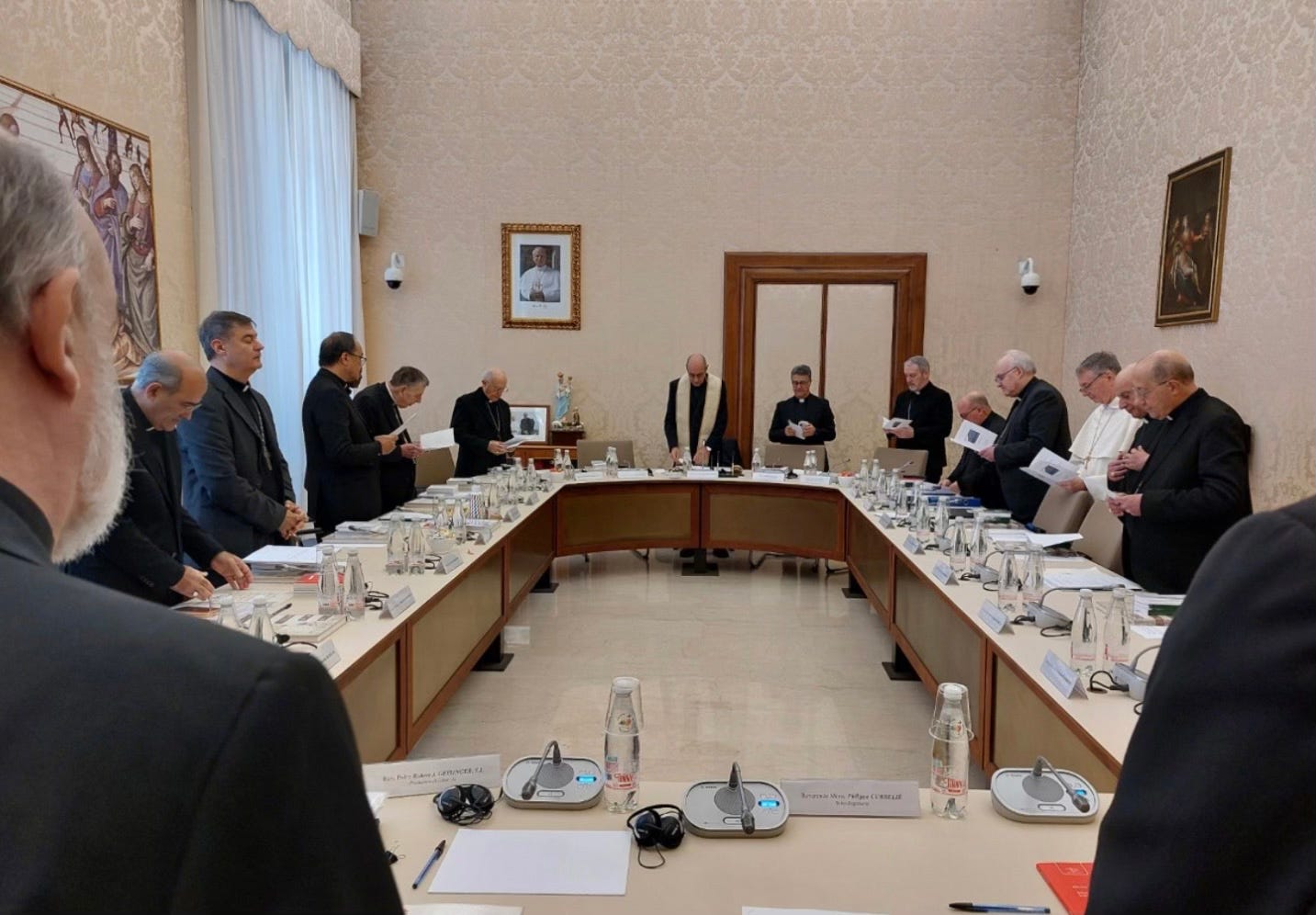
Credit: DDF website
Reading Cardinal Fernandez’s speech for the Opening Session of the DDF, I am tempted to paraphrase the great Flannery O’Connor – if it’s not the truth, to hell with it!
Fernandez says that we cannot know “reality in its totality and in every one of its aspects.”
“This is possible only for God,” he says, stating the obvious.
The conclusion he draws from this, however, is that we can’t say we really know anything at all.
“The problem is that, for this reason, we cannot have a complete understanding of even a small part of this world, since that same part can be understood fully only in the light of the totality in which it is integrated, for everything is connected,” Fernandez said.
“Consequently, we are incapable of interpreting all the meaning and nuances of a reality, a person, a historical moment, or a truth.”
“Naturally, this applies all the more to the truths of the faith,” Fernandez continues. “Today a theologian normally possesses knowledge limited to a single theological discipline or an isolated topic, whereas the mysteries of faith are interwoven in a rich hierarchy, in which the whole is especially illuminated by those central truths that constitute the heart of the Gospel.”
(I hope it will have occurred to at least one theologian listening to this talk that the Cardinal has put us into a conundrum: if we are incapable of knowing the truth of things, then we have no basis to claim to know the central truths of the Gospel either.)
As he does often, the Cardinal then brings in various quotes from serious Catholic thinkers, this time St. Thomas Aquinas -whose life is a testament to the capacity of our intellect to know things about God and the world - to support his troubling thesis.
In the end Fernandez says, quoting Bonaventure, that “interior silence is more helpful than external speech;” praying is better than speaking.
But, of course, the office of which he is Prefect is called precisely to speak on the truths of the faith, as Pope Leo’s address to the DDF on Thursday plainly pointed out.
“Your task is to offer clarifications regarding the doctrine of the Church, through pastoral and theological guidance,” Pope Leo said.
The work of the DDF, Leo said, “offers the faithful a prompt and clear word from the Church.”
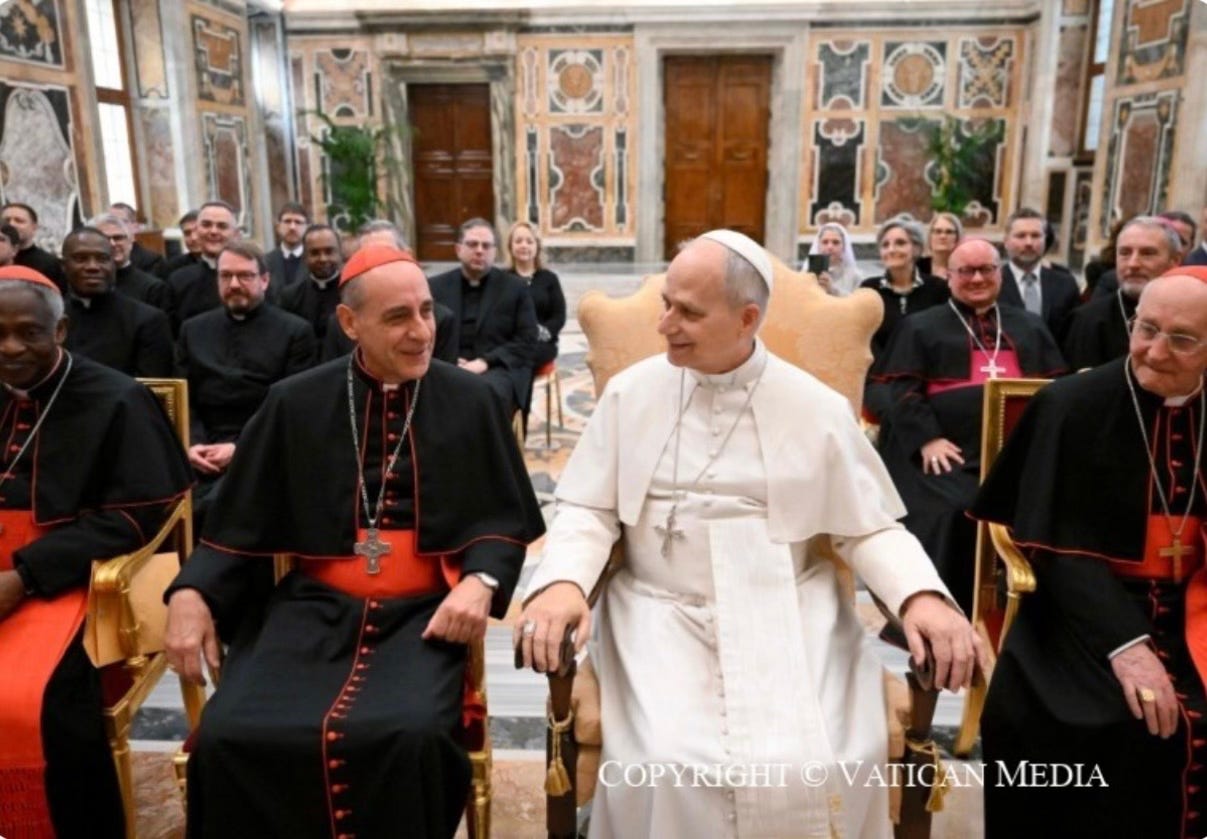
Regardless of whether Card. Fernandez remains as Prefect, it is worth paying attention to what he says because this post-modern approach to truth is a hallmark of progressive Catholic thinking and at the heart of current divisions in the Catholic Church.
THE PROGRESSIVE VIEW
Part of the progressive playbook is to move away from any sort of metaphysical or moral certainty, which they deem too arrogant and narrow-minded, to a larger view of the mystery of God, the not-knowing, and the beauty of love and mercy, better expressed through poetry than doctrine. They speak of the “central truths of the Gospel” to distance the life and teachings of Jesus from doctrine which they find too constraining.
That the “central truths of the Gospel” and moral and metaphysical truth might actually fit together and be one of the great achievements of the Catholic Church does not seem to be a consideration for them. The Bergoglian/Fernandez approach involves a competition between love and truth wherein truth has played a divisive and damaging role and love is the answer.
Examples abound in the documents and speeches of Francis but here’s an insight into that thinking from an interview Cardinal Fernandez gave two years ago on the question of immortality.
“For many years, this was the fulcrum of Christianity: if you behave properly you will go to Heaven; if you are bad, you go to Hell. But is this the fulcrum of Christianity? No. It was a way of using people’s fear of death,” Fernandez said.
“That message responded to an old situation, but it doesn’t work today. Pope Francis insists on a different type of message in which the center is in another place: in mercy, in love.
“The heart of Christianity, for the Pope, is the love of God. The love of God which is given to us and manifested in Christ crucified. And when you encounter that, you are no longer obsessed by eternal life.” (Il Folle di Dio alla Fine del Mondo, Javier Cercas)
This answer encapsulates a typical Bergoglian/Fernandez approach: create a straw man (those “obsessed” by the question of eternal life or the mean Church “using people’s fear of death”) dismiss it as passe’ or rigid and oppose it to the virtue of love or mercy.
This disingenuous approach however comes from a genuine place of believing there is a wrong that needs redress – for them that would be the Catholic Church’s perceived over-emphasis on rationality, truth and rules versus a more understanding, flexible Church based on love and mercy.
You will not be surprised to know that Joseph Ratzinger, too, had considered this problem many years ago:
“I must say that I felt very strongly within myself the crisis of the claim of truth during the decades of my teaching work as a professor. What I feared was that the way we use the idea of the truth of Christianity was sheer arrogance, yes, and even a lack of respect for others. The question was, how far may we still use it?
“I have really thoroughly explored this question. In the end I could see that if we abandon the concept of truth then we abandon our foundations. For it is characteristic of Christianity from the beginning that the Christian faith does not primarily transmit practices or observances as is the case with many other religions, which consist above all in the observance of certain ritual rules.
“Christianity makes it appearance with the claim to tell us something about God and the world and ourselves – something that is true and that enlightens us. On this basis I came to recognize that, in the crisis of an age in which we have a great mass of communications about truth in natural science, but with respect to the questions essential for man we are sidelined into subjectivism, what we need above all is to seek anew for truth, with a new courage to recognize truth. In that way, this saying [co-worker of the truth] which I have chosen as my motto, defines something of the function of a priest and a theologian, to wit that he should in all humility and knowing his own fallibility, seek to be a co-worker of the truth.”(God and the World p. 263)
So Ratzinger and Bergoglio/Fernandez actually agree on the potential problem: that truth can be used in a way which is arrogant and lacking in respect for others, but they offer two different solutions.
Ratzinger’s was to go more deeply into truth and attempt to explain its importance and connection to love and faith.
Fernandez/Bergoglio go for downplaying the importance of, and even possibility of, truth.
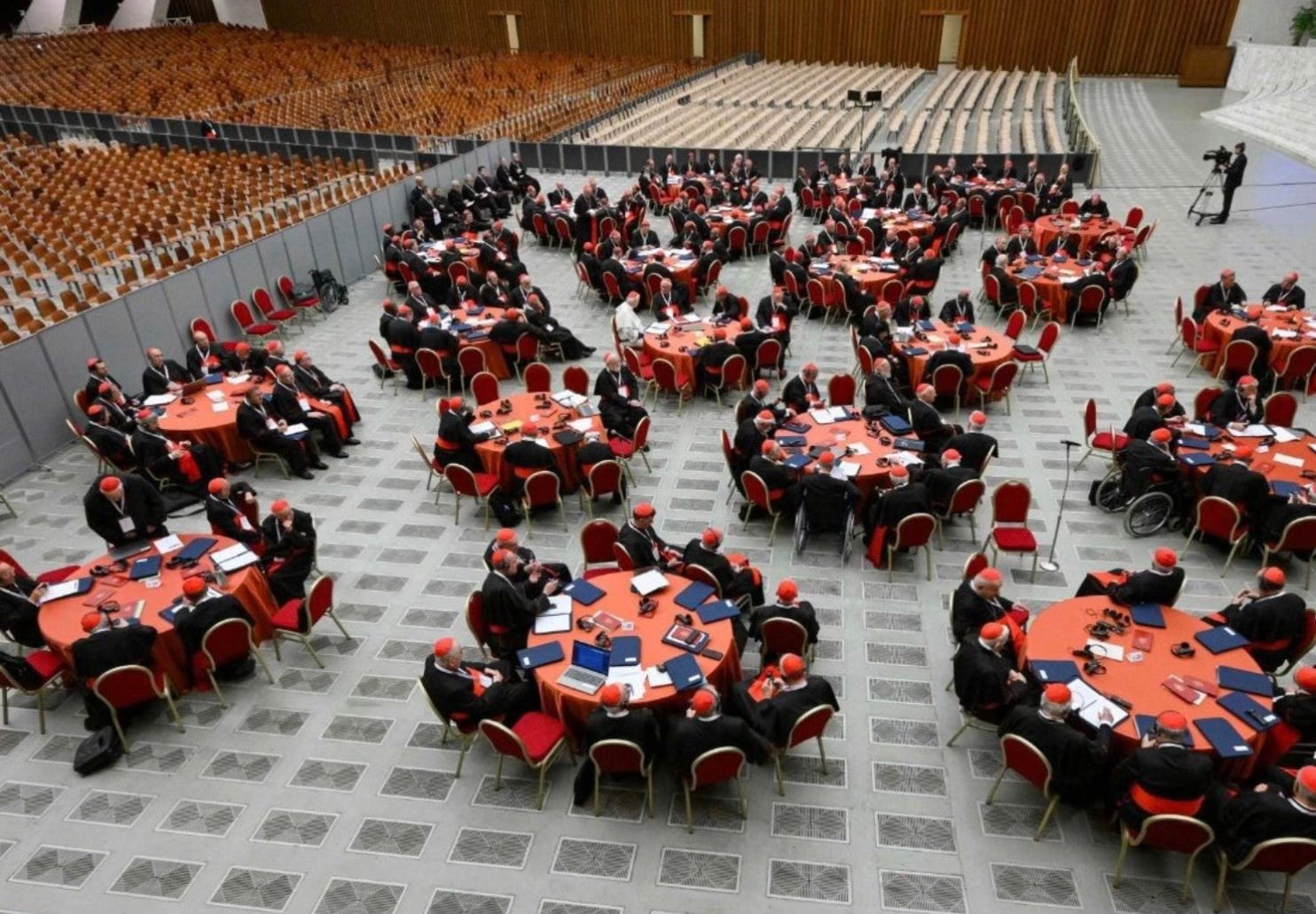
Credit: Vatican media
Let’s take a look at just a portion of Cardinal Fernandez’s talk at the Extraordinary Consistory held in early January and notice the similarities with his talk to the DDF. (The talk is entitled “Rereading Evangelii Gaudium”. It is only published in Italian and Spanish on the website so the English below is my translation.)
“Evangelii Gaudium also specifies that it is not about an obsessive proclamation of all the doctrines and norms of the Church, however necessary and precious, but above all it is about the nucleus of the Gospel, the kerygma.
“Its content is ‘the beauty of God’s salvific love manifested in the death and resurrection of Jesus Christ.’ (n.36)
“Benedict XVI has already underscored that one does not become a Christian because of a doctrine or moral teaching: it is the experience of an encounter which constitutes the foundation of everything.
“The missionary synodal reform, in the final analysis, consists in putting in second place that which does not directly serve in reaching everyone with this first announcement. Therefore everything that leads us directly to this principal objective must be placed first.
Notice, again, the diminishment of doctrine which is “obsessive” versus love. And again Fernandez makes recourse to a partial reading of a serious Catholic theologian – in this case Benedict – to support his thesis.
It is a subtle sleight of hand because Benedict would indeed agree that being a Christian is about the encounter with Jesus, but he would not agree that therefore doctrine should take a back-seat. On the contrary, Benedict spent much time explaining how doctrine gets a bad name but is actually the formulation by Christians about what that encounter with Jesus means. So the two are necessarily intertwined.
CHARITY WILL REPLACE TRUTH
What Tucho says is important for understanding the foundations and future of the progressive Catholic project. There are different degrees of progressivism within the Catholic Church and they themselves may not be in agreement about their ultimate vision for the Church, or even know what it is. But it is useful to listen to one of the most radical of progressive theologians, the late Gianni Vattimo, to get an idea of what is at stake:
“As I see it, Christianity is moving in a direction that cannot but lighten or weaken its moral load in favor of its practical-moral charity…charity will eventually replace truth.
“The future of Christianity and also of the church, is to become a religion of pure love, always more purified.
“By saying this, I am not putting forth the usual message of tolerance. Instead, I am speaking of the ideal development of human society, hence the progressive reduction of all rigid categories that lead to opposition, including those of property, blood, family, along with excesses of absolutism. The truth that shall set us free is true precisely because it frees us. If it does not free us we ought to throw it away,..”
“By recovering this message of charity it allows for the lightening of dogmatic burden and a new spirit of ecumenism to fill the church…now it is time for Christianity to realize this non-religious destiny which is its own.” (Excerpts from Death of God & Towards a Non-religious Christianity)
I have quoted Vattimo at length, not to draw any direct connections with Cardinal Fernandez, but to explain where Tucho’s line of reasoning can lead.
I do not know if the Cardinal would agree with Vattimo. I do know that Pope Francis read Vattimo, called him in July 2018 to thank him for one of his books, Being and Surroundings, and that Vattimo credits Pope Francis for his return to the Catholic Church.
I appreciate Vattimo because at least he had the courage to take the progressive argument to its logical conclusion, which is the abolishment of the Catholic Church as we know it.
To return to Tucho. I think these two talks are indicative of the great divide which has been brewing since the Second Vatican Council which can be generally summed up as moving the Catholic Church away from Truth which was hitherto thought to be knowable and decisive for our lives, particularly any supernatural truths or language, (questions of the soul/eternal life used to be considered fundamental questions of faith, not only ones of the “obsessed”) towards a Church which proclaims only part of that Truth, such as love of neighbor, the poor, the environment etc – as is acceptable in a post-truth society.
One final point on the Cardinal’s DDF meditation which should not go unremarked.
I have said before that Tucho spends too much time on the Internet. He calls others obsessed but he himself is continually incensed by blogs that dare to engage in dialogue with his thoughts.
During his speech for the opening of the Plenary Session of the DDF (which presumably has more important matters to be considering) he once again took a dig at Catholics “who haven’t even studied much theology” expressing their opinions on the Internet.
Instead of seeing responses from Catholics as a modern exercise of synodality, ostensibly much desired by the Vatican, Card. Fernandez decries that his interlocutors do not have theology degrees.
Clericalism, anyone?
Let us hope that in the pontificate of Leo such petty derisions of the people of God will be put away so that we may all join together and put on Christ.
What I find fascinating is that the very thing that Tucho and Francis give as the selling point of their vision (the appreciation of nuance and the downplaying of authority) is the very thing that makes their arguments so dated and transient. Tucho's Fiducia supplicans was forgotten almost as soon as it was promulgated, including by Pope Francis. Within six months of the document he was on TV saying that it didn't apply to gay couples but gay people as individuals, despite the text very clearly saying it applied to gay couples.
The Marian document was supposed to be a bold new course for the Church.... that was instantly shrugged off by said Church, leading Tucho to say "relax guys, all this means is that the Church won't mention the term mediatrix in a future ecumenical council", which instantly gave everyone permission to not care about it. Their obsession with creativity, nuance and politicking in magisterial documents just made those documents even less relevant, and now makes their legacy already fading, and Francis' body hasn't even been cold for a year.
Well said. Thank you for your insights. They are good contributions to the discussion.